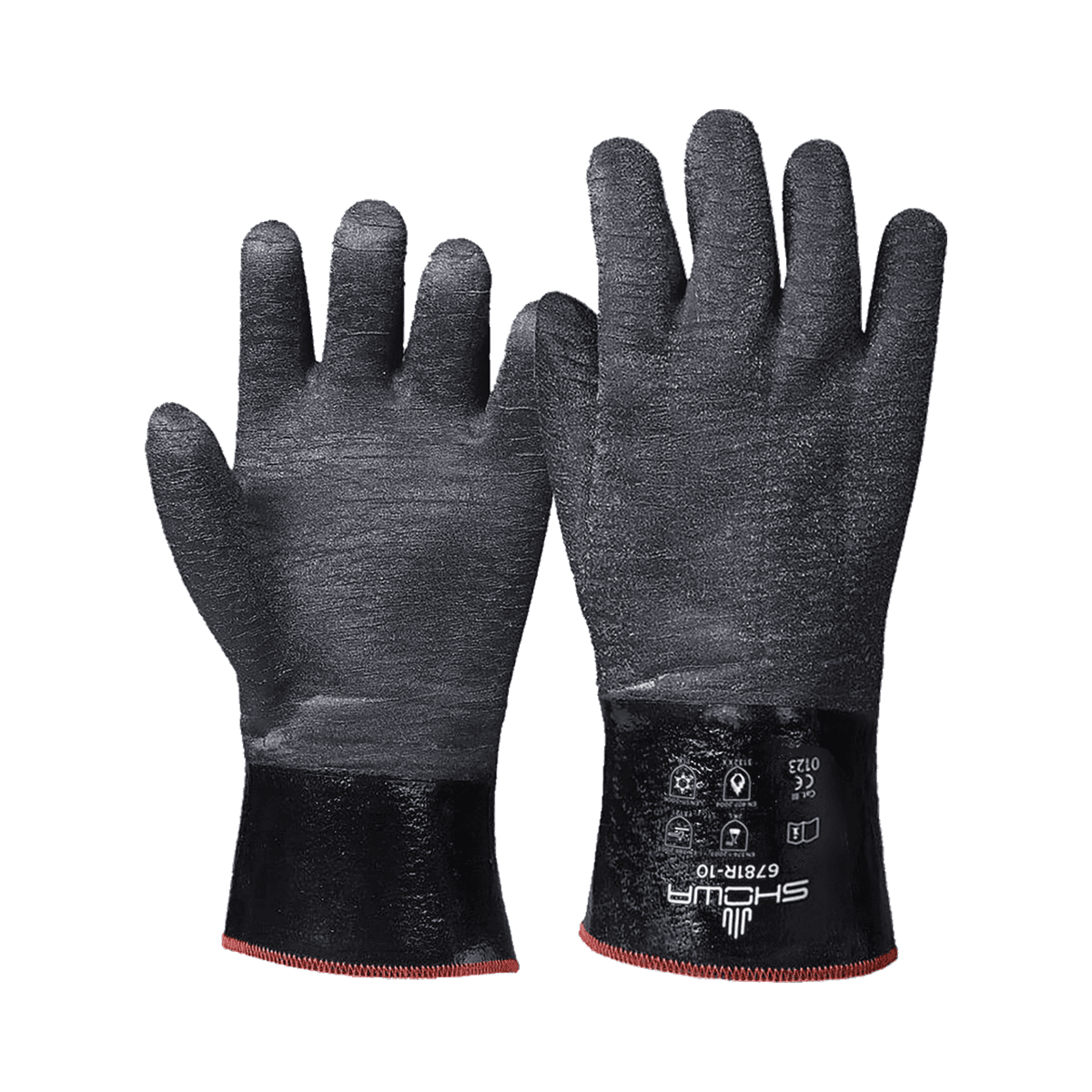
EN ISO 374-1 sets the requirements for gloves protecting against dangerous chemicals. The key concept is permeation — the movement of a chemical through the material at molecular level, invisible to the eye.
The three types
| Type | Requirement | Pictogram |
|---|---|---|
| Type A | ≥30 minutes against at least 6 test chemicals | Flask with six letters |
| Type B | ≥30 minutes against at least 3 test chemicals | Flask with three letters |
| Type C | ≥10 minutes against at least 1 test chemical | Flask with no letters |
Test-chemical codes
| Code | Chemical |
|---|---|
| A | Methanol |
| B | Acetone |
| C | Acetonitrile |
| D | Dichloromethane |
| E | Carbon disulphide |
| F | Toluene |
| G | Diethylamine |
| H | Tetrahydrofuran |
| I | Ethyl acetate |
| J | n-Heptane |
| K | Sodium hydroxide 40% |
| L | Sulphuric acid 96% |
| M | Nitric acid 65% |
| N | Acetic acid 99% |
| O | Ammonium hydroxide 25% |
| P | Hydrogen peroxide 30% |
| S | Hydrofluoric acid 40% |
| T | Formaldehyde 37% |
Permeation levels
| Level | Breakthrough time |
|---|---|
| 1 | > 10 minutes |
| 2 | > 30 minutes |
| 3 | > 60 minutes |
| 4 | > 120 minutes |
| 5 | > 240 minutes |
| 6 | > 480 minutes |
An important caveat: breakthrough time is measured in the laboratory at 23 °C on a static sample. In real work temperatures are higher, the hand moves and the material stretches — so the safe working time is always shorter than the declared figure. Halving it is common practice.